
Guide
When an elderly parent hides a fall
 Silvie·5 min read
Short answer: elderly parents hide or downplay falls because admitting one can cost them their independence. They are usually not lying. The fix is not to argue about whose version is right, but to give the family one neutral record of what happened so everyone can make a single decision together.
It was nothing. I just lost my balance. That is how the parent tells it, and often they believe it. But the adult child far away hears the same story and fears the worst, and the sibling who found them on the floor is somewhere in between. Within a day, one fall has become three different stories.
Why parents hide falls
- Independence is the real stake. A reported fall can start a conversation about moving out. Minimizing it protects the life they want.
- They do not want to be a burden. Many older adults track how much worry they cause and manage it deliberately.
- Memory is genuinely unreliable after a fall. Especially with a head impact, or in early dementia.
- It happened when nobody was there. Most falls have no witness, so the only account is the one that bends.
Why families end up arguing
Nobody is lying. The retelling bends with pride, with fear, and with distance. A far-away sibling catastrophizes because guilt fills in what they didn't see. The one on the ground splits the difference because they are tired.
The family burns its energy arguing about whose version is right instead of deciding what to do next.
If you have been in that group chat, you know the argument was never really about the facts. It was about not having any facts everyone could trust.
Signs a fall happened that nobody mentioned
- New bruising, often explained vaguely or attributed to something else
- Suddenly avoiding stairs, a bathtub, or a favourite chair
- Furniture moved to create handholds along a route
- A long unexplained gap in the day, or a much later start than usual
- Reluctance to talk about a specific day at all
What actually helps: a record nobody has to defend
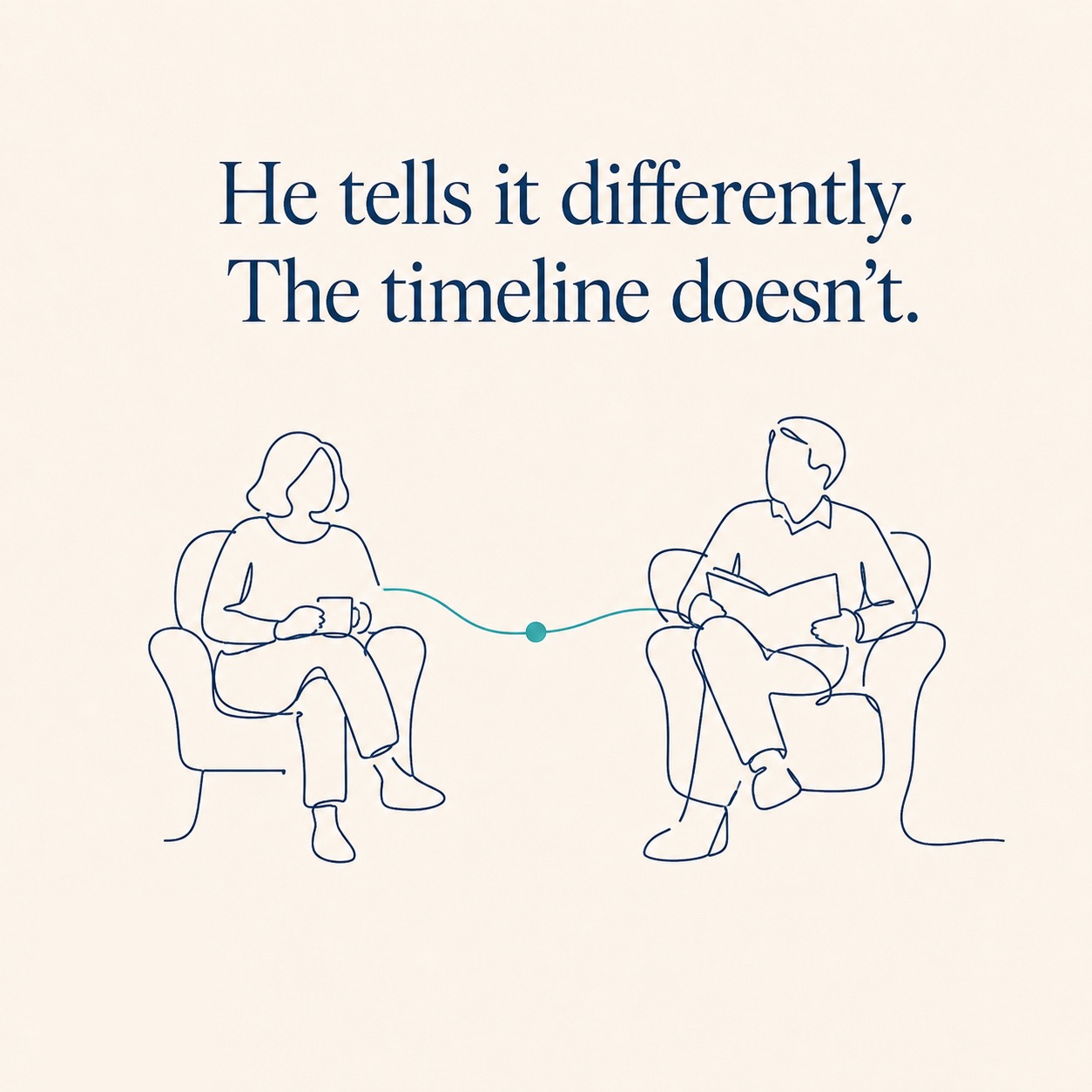
What ends the argument is not another opinion, and not a winner. It is a shared, factual timeline of the night that neither minimizes nor exaggerates: what time they got up, which room, how long in one place, when the quiet returned.
A timeline like that takes the burden of proof off every person in the family. The parent doesn't have to defend their version. The siblings don't have to prosecute theirs. Everyone reviews the same evidence, and the conversation moves from what happened to what now.
Worth being honest: no system detects every fall, and anyone promising that is overselling. What a passive record reliably gives you is the surrounding pattern, which is often what makes the intervention possible. More on that in more than a fall alarm and fall detection without a camera.
How to raise it without a confrontation
- Do not open with proof. Open with the worry, and with what they keep by staying home.
- Ask what they want to happen if they cannot get up, rather than debating whether it happened.
- Bring the siblings into one conversation rather than three parallel ones.
- Agree in advance what would trigger a change, so no one relitigates each incident.
For the wider conversation, see talking to a parent who refuses help, and keeping an aging parent safe at home.
Dignity, kept

The parent still gets to tell the story their way at dinner, and nothing about a quiet record takes that from them. No camera watching, no microphone listening, nothing to wear or charge or remember. The family finally has one account it can trust, and one decision to make together instead of three arguments to lose separately.
Common questions
Why do elderly parents hide their falls?
Because reporting a fall can threaten their independence. Admitting it may trigger conversations about moving out or bringing in help, so minimizing feels like protecting the life they want. Many also genuinely misremember the event, particularly after a head impact.
How do I know if my elderly parent fell and didn't tell me?
Look for indirect signs: unexplained bruising, avoiding stairs or the bath, furniture rearranged as handholds, a much later start to the day, or reluctance to discuss a specific day. A change in daily pattern is usually more telling than the account you are given.
What should I do after a parent has a fall they downplayed?
Focus the conversation on what happens next rather than on whose version is correct. Agree as a family on what would trigger a change, and get one shared account of events so each new incident is not relitigated from scratch.
Can falls be detected without a camera?
Yes. Passive sensors can report activity, rest and room-level movement without images or audio. No system detects every fall, but the surrounding record of the night is often what lets a family intervene hours sooner.
No wearable, no camera
See how a small sensor gives your family a quiet way to know a parent is okay, without cameras or anything to charge.
Explore Silvie