
Story
Caring for aging parents and children at the same time
 Silvie·5 min read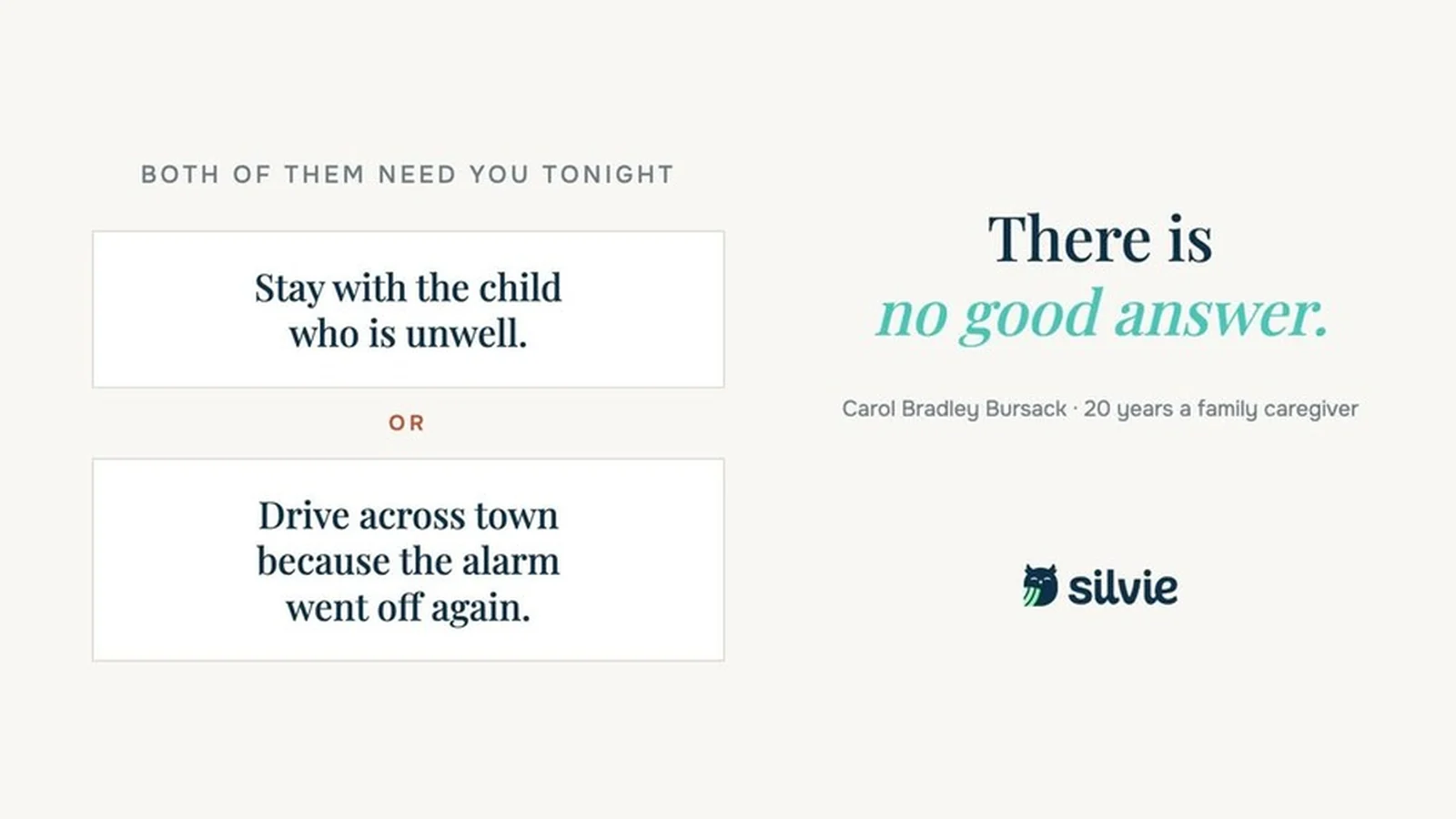
Short answer: the hardest part is not the workload. Your child and your parent can need you in the same hour. You can only be in one place. You can't change that. You can cut the number of nights you drive over without knowing if you had to.
Carol Bradley Bursack was the primary caregiver for seven older adults across twenty years, while raising a family. She described an evening that many caregivers will know.
Do I stay home with my kid who's not feeling well, or do I run because mom might have fallen?
She added: “Whatever decision I make, it's not going to be right. Because with caregiving, so often there is no good answer.”
Why there is often no good answer
- The needs arrive together. A child's fever and a parent's fall can happen on the same night.
- Both matter. That is why the choice is so hard.
- You don't have the facts when you need them. You don't know if she fell. Finding out can take the whole evening.
- You are the fallback. Often one person in the family makes the call. They rarely get to hand it to someone else.
The guilt is not a sign you are doing it badly
Carol names the guilt plainly, after twenty years of caregiving. She still felt pulled apart. No schedule or system makes that feeling go away. It comes with being the person who has to choose.
What you can change is how often you decide without the facts.
What actually helps
- Decide what counts as an emergency, before the night happens. For your child and for your parent. Agree on the rule ahead of time, not at 9pm.
- Name your backups out loud. Ask a neighbor to agree to knock on the door when needed. Don't just assume they would help.
- Get the siblings onto one thread. Put everyone in one group chat, so you all see the same facts. See when one sibling carries the load.
- Reduce the unknowns. Much of the stress comes from not knowing if the drive was needed.
- Let the daily check stop being a phone call. More on that in how to know if an elderly parent living alone is okay.
You still cannot be in two places
Nothing removes the night Carol described. If your parent needs someone in the room, someone has to go. A sensor at home can answer simple questions. Is she up? Is she moving between rooms? Did she get out of bed this morning? It does not prove she is safe, and it does not detect every fall.
No system detects every fall. Be careful with anyone who promises that. Silvie has no camera and no microphone. Your parent has nothing to wear or charge. See fall detection without a camera, is my parent being watched, and caring for a parent from far away.
Common questions
What is the sandwich generation?
Adults who are raising or supporting children while also caring for an aging parent. The hard part is that a child and a parent can need you at the same time.
How do you care for a parent and a child at the same time?
Decide in advance what counts as an emergency for your child and for your parent. Then you don't decide from scratch every time. Ask specific people to be your backups. And cut the unknowns. Much of the stress comes from not knowing if the drive is needed.
Why does caregiving guilt feel so unavoidable?
On the hardest nights, no option meets everyone's needs. Feeling guilty then does not mean you are doing it badly. It comes with being the person who has to choose.
What actually reduces the load for a working caregiver?
Anything that turns an unknown into a fact. Knowing a parent got up, moved around, or rested through the night can remove a check-in drive that turns out not to have been needed, which is often the difference between a hard evening and a lost one.
No wearable, no camera
See how a small sensor on the wall shows you when your parent is up and moving. No camera, nothing to charge.
Explore Silvie