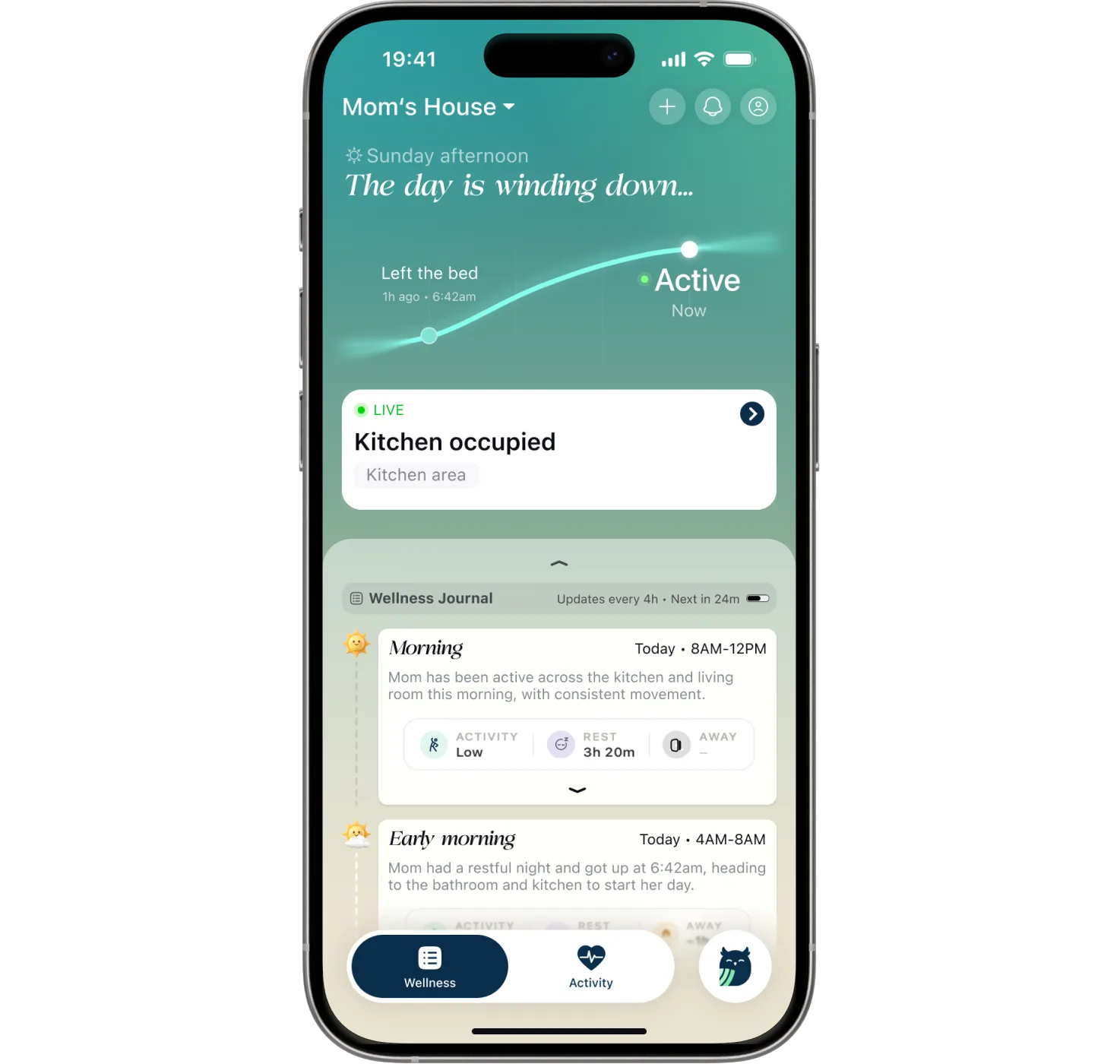
Everyday awareness
Know they're okay, without checking in
Silvie learns your parent's daily rhythm and gently flags when something is off, like getting up much later than usual. Peace of mind between the phone calls.
You live an hour or a continent away, and the question is always the same: is Mom okay right now? Here is every real way to answer it, and what each one costs in money, effort, and your parent's privacy.
Families don't want to watch a parent; they want to stop worrying. Those are different products. Watching means a feed you have to check. Awareness means you hear about the two things that matter, an emergency right now, and a slow change in the daily rhythm, and hear nothing the rest of the time.
Judge every option below by that standard: does it tell you what matters without you checking, and what does it ask your parent to accept in exchange?
From lowest-tech to highest, with the trade each one makes.
| Check-in calls | Pendant | Camera | Motion sensors | Radar | |
|---|---|---|---|---|---|
| Knows about a fall automatically | No | Only if worn | Yes | Infers | Yes |
| Nothing for your parent to wear or do | No | No | Yes | Yes | Yes |
| No images of your parent | Yes | Yes | No | Yes | Yes |
| Covers night & bathroom | No | Yes | No | Partly | Yes |
| Sees the daily rhythm, not just emergencies | What they tell you | No | If you watch | Yes | Yes |
If the goal is one system that answers "is something wrong right now?" and "is the pattern changing?" without a camera and without depending on your parent's memory, that's the radar profile. How detection itself works is in what is fall detection.
Silvie learns your parent's daily rhythm and gently flags when something is off, like getting up much later than usual. Peace of mind between the phone calls.
Silvie uses intelligent radar sensing to understand movement and daily activity completely privately, with no cameras, microphones, or wearables required. A fall alerts your emergency contacts in seconds; the everyday view shows the rhythm, not a video feed.
See how it works