
Story
A daughter's story
 A Silvie family·4 min read
Every family with an aging parent living alone knows the ladder. You text. You wait. You call. You wait. You call someone who lives nearby. And if none of that works, someone gets in the car.
The ladder has a hidden cost beyond time: every step runs on dread instead of information. You escalate because you cannot see, not because you know something is wrong.
Twelve hours of nothing
One daughter we work with lived a sharper version of this. For a month, her father's overnight arrangements fell through: morning help arrived at 9am, evening help left at 9pm.
“We were flying completely blind from 9 at night till 9 in the morning.”
The family had tried wearables. In her words: “We've gotten you every chargeable, wearable thing. You don't charge it. Nobody even knows where the pieces are.” So they installed Silvie: small contactless sensors, placed high in the corners of his rooms. No camera. Nothing for him to wear, charge, or remember.
The morning the home looked empty
At 6:30 one morning she checked the app and it showed the home as vacant. She knew he had not gone anywhere. So she opened the overnight history.
It showed him at his desk chair at 2am. It showed him there until about 3:30. Then nothing.
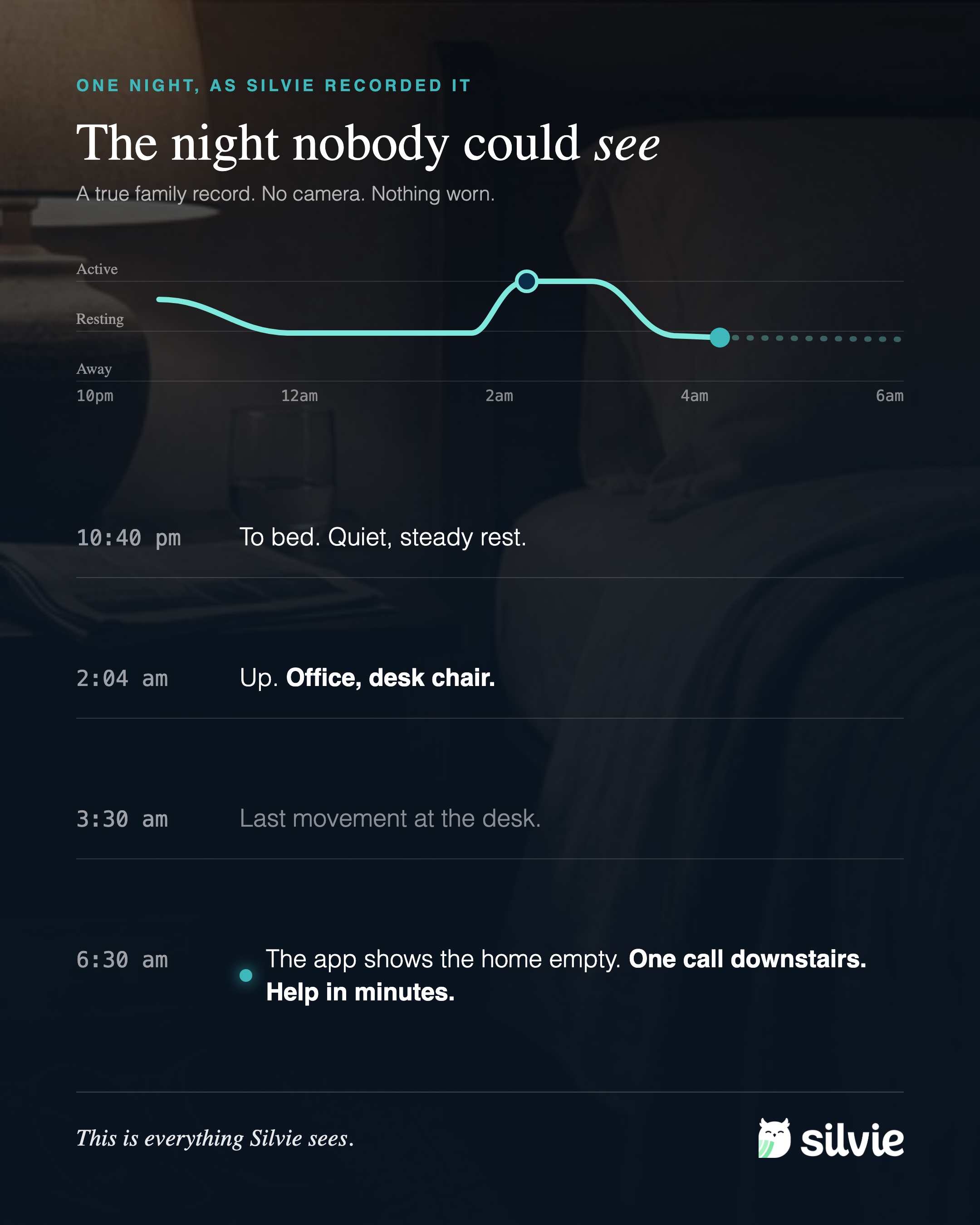
She did not need a siren to know what that meant. He had fallen asleep in the chair, and he was now on the floor beside it. She called someone in the building, who went up and helped him back to his feet.
Escalating on evidence, not dread
Notice what changed. The ladder is the same ladder, but she entered it at step three, immediately, with a specific reason and a specific location. No hour of unanswered calls. No guessing whether to spend the favor. The record turned “I have a bad feeling” into “he has been on the floor by the desk since 3:30.”
The record did something else the family did not expect. Her father, like many proud people, tends to shorten the falls when he retells them: not that long, not that often, not where you think. Those conversations used to be arguments. Now they are gentler and shorter.
“Dad, I actually have the evidence now.”
Not to win. To skip the part where nobody can agree on what happened, and get to the part where the family decides what to do next.
What Silvie did not do
Honesty matters more than a clean story. Silvie did not detect this fall as it happened. There was no alert at 3:30am. What it held was the record around the fall: which room, until when, and the silence after. That was enough for one phone call to reach him hours sooner, and for a month alone to be survivable for the whole family.
“I don't know what we would have done without it this past month. Truly.”
If you are at the top of the ladder right now
Two things we have learned from families like this one.
First, the gap is almost always overnight. Daytime has helpers, calls, deliveries, neighbors. From the last helper leaving to the first one arriving, nobody can see anything. Whatever you set up, set it up for those hours first.
Second, whatever you choose has to work without your parent doing anything. If it needs charging, wearing, or remembering, the story above tells you how that ends. Passive coverage of the home beats a device in a drawer.
Have a story to share?
If Silvie has changed things for your family, we would love to hear it.
Explore Silvie